
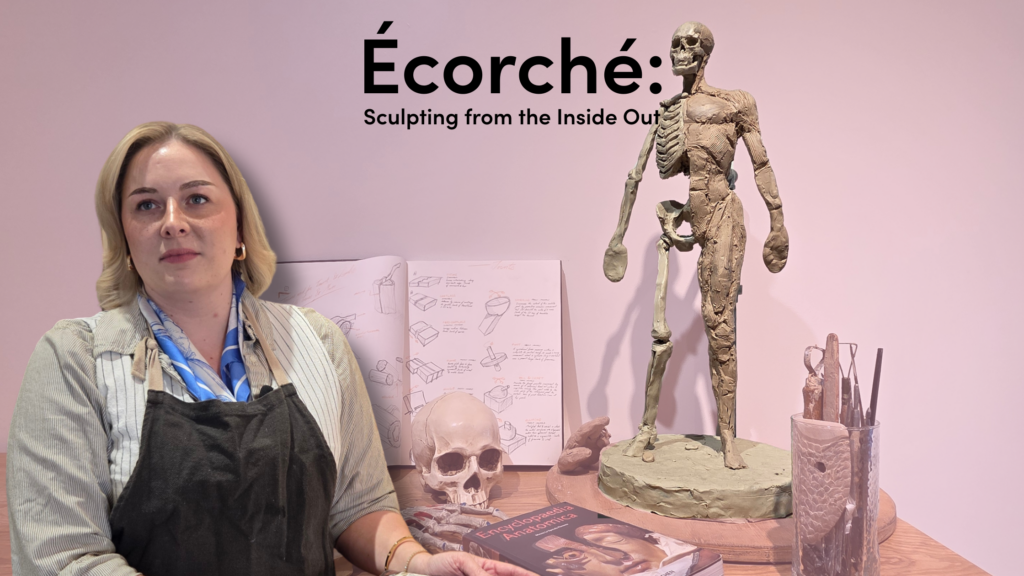
At Craft Alliance, we often talk about the “soul” of an object, but for artist and instructor Morgan, the focus starts much deeper—at the bone. Morgan’s practice involves écorché, a traditional method of sculpting the human figure from the inside out. It is a rigorous, analytical process that blends 18th-century medical history with contemporary fine art.
We sat down with Morgan Laughlin to discuss her “magnum opus” sketchbook, the weight of artistic lineage, and why understanding the “dance” of deep tissue is essential for any figurative maker.
CA: You describe your process as “sculpting from the inside out.” Why start with the skeleton rather than just the surface we see?
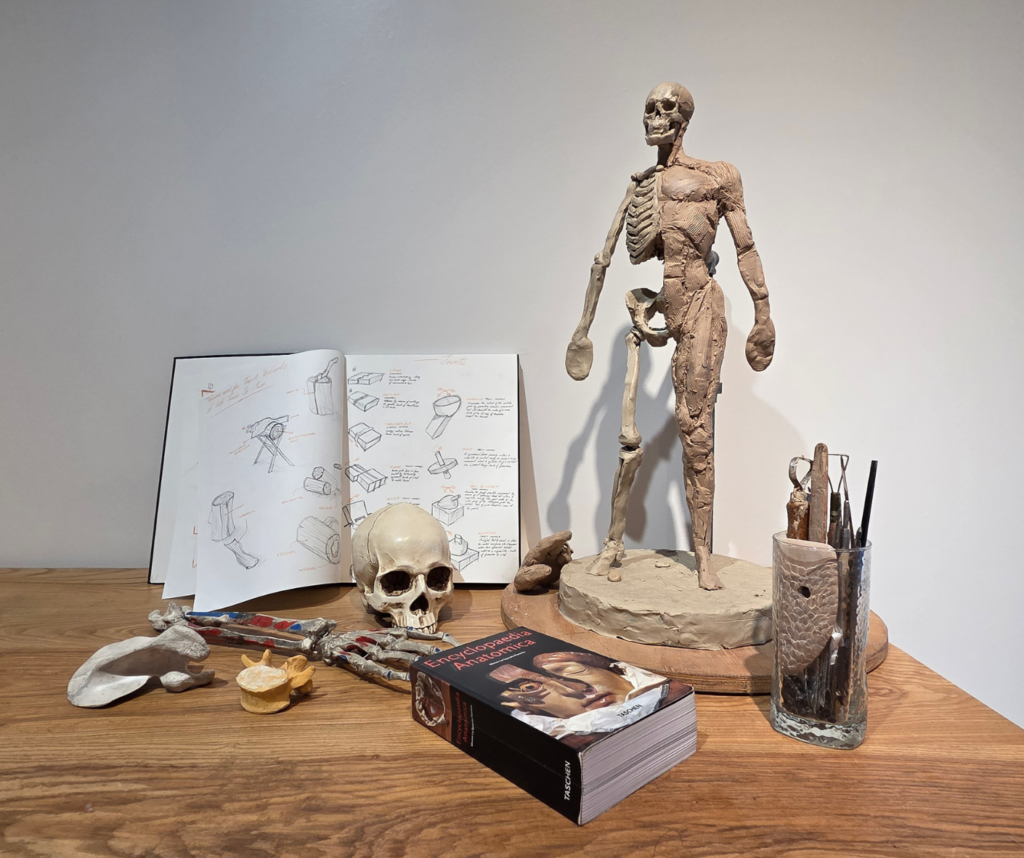
Morgan: When you’re first starting in écorché, you are truly starting with the absolute bare bones from day one. In my practice, you sculpt a complete skeleton—both sides fully completed—and then cover only half in musculature.
The body is in complete harmony with itself. If a knee is tilted, the muscles in the front of the thigh engage, which in turn engages the back muscles. You only truly understand that “tandem dance” that happens across the entire body by understanding the deep muscles that define why we see what we see on the surface.
The “Dialect” of a Mentor
CA: You speak very passionately about the history of this craft. How does that history influence your hands today?
Morgan: I think of craft as something handmade and passed from one person to another; I can see my artistic lineage in my work. It’s like learning a language—you pick up a specific dialect from your teacher.
My mentor, David Newton, was trained in the classic Italian school, and I can see his “fingerprint” in how I build my armatures. St. Louis actually has a long history of this very classical training, from David to artists like Bob Cassilly and Ralph Torrini. We are carrying on a tradition that dates back to the wax casting of the 18th century.
The Mastery of the Handmade
CA: In an age of 3D printing and digital models, why spend 400 hours on a single oil-based clay sculpture?
Morgan: There are no shortcuts to the mastery of craft. There is inherent value in the “cognitive work” of working out these issues by hand. I think of the arts in a similar way to a trade school. We should have the same pride in our craftsmanship as a carpenter, a plumber, or a pipefitter. When I can say “with my whole chest” that a piece is anatomically accurate, there is an immense sense of pride in that dedication.
A Different Way of Seeing
CA: Does this level of study change how you interact with the world outside the studio?
Morgan: It absolutely changes how you view people walking around. You become aware of the harmony and the tweaks. If someone has a slight gait, I’m thinking about the weakness in the lower ankle bones or how the neck muscles are compensating for dental work. How we live our lives shows on our bodies—there is no workaround to that.
CA: What makes the Delmar Maker District the right place for this kind of work?
Morgan: The community. It doesn’t matter if you are a blacksmith at the forge or a weaver at the loom; we are all cut from the same cloth. We are all equally happy to be cheerleaders for each other’s dedication to the handmade