
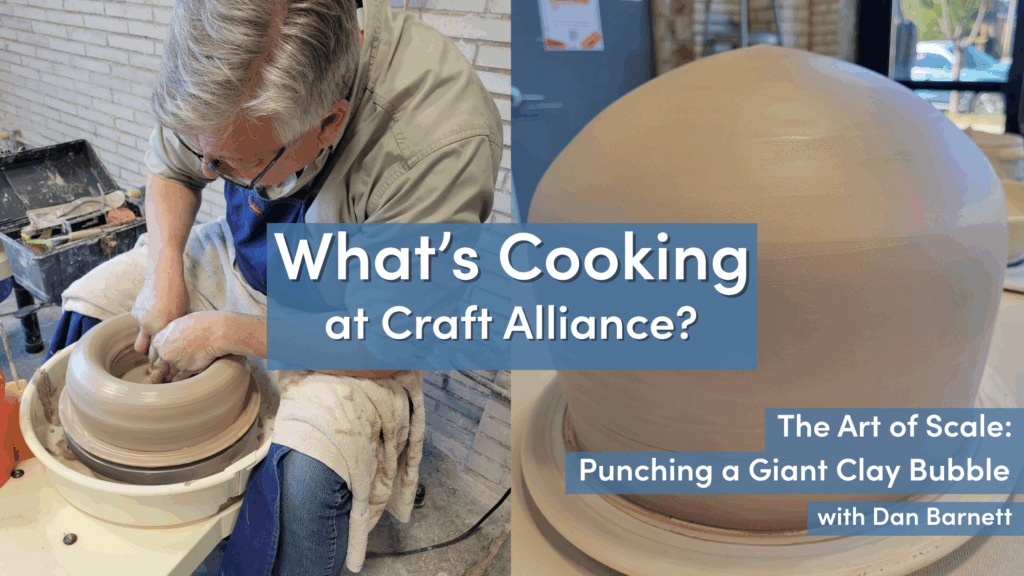
Dan Barnett is an accomplished artist and educator deeply rooted in the St. Louis metropolitan area. He earned his BFA in Ceramics and Sculpture from Southern Illinois University Edwardsville (SIUE) in 1997, where he also developed skills in Blacksmithing. Since 1990, Dan has been a practicing artist focused primarily on Ceramics, and he has shown nationally and internationally, including exhibitions at the Craft Alliance and the Biennale Internazionale dell’Arte Contemporanea di Firenze in Florence, Italy.
A dedicated educator for 28 years, Dan has taught Ceramics professionally at institutions across the region, including SIUE, Lewis & Clark College, St. Louis Community College at Meramec, and, currently, the Craft Alliance in University City, MO. Beyond teaching, Dan is a skilled kiln builder: he designed and built a hybrid Fastfire Kazegama at his home in Worden, IL. He uses this kiln to hold classes in wood firing techniques for local colleges and faculty, while also maintaining his personal studios in Ceramics and Blacksmithing.
In this interview, Dan shares a brilliant, highly unusual technique for manipulating large masses of clay—a process that can be used to create oversized vessels, unique bowls, or even precise slump molds for collaboration. His method—using two separate balls of clay and a dramatic punch—is a master class in efficiency and physics that helps potters work bigger without relying solely on brute force.
The Two-Ball Strategy: Efficiency Over Brute Force
The process begins unconventionally: Dan separates the total clay mass (about 15 to 20 pounds) into two or three smaller balls, centering them one by one.
Q: Why did you choose to center the mass in two separate, large balls instead of a single colossal lump of clay?
“When I’m teaching, I try to show people the most effective way of utilizing their strength without over-stressing themselves. Ceramics is a very physical activity1. When you suddenly double or triple the amount of clay you’re working with, you need a lot of strength in your wrists and arms.”
“The biggest problem with a single large mass is centering. When you have 15 or 20 pounds swinging around as a single object, it’s really hard to center it because it bounces back at you. If I break that up into two seven-pound layers, I center the first, slap the second one down (making sure to wick off any water), and then center it again. All of a sudden, each center is completely centered, and when you compress down, it melds it into one. It’s much easier to get it centered this way.”
Adhesion and the Punch Center
Dan relies on a combination of impact, compression, and a specific technique called “punch centering” to fuse the clay masses and create a stable base.
Q: How do you ensure the second ball, wrapped around the first, is perfectly adhered and integrated, preventing a seam or weak point?
“The combination of bringing the second ball on top and then hammering it down starts to blend the clay pretty quickly. Then, when you transition into punch centering a little bit later, it basically compresses through the whole pile. It drives out all the clay from the center out toward the outside, and it melds it very, very cleanly.”
Q: Tell us more about the technical role of “punch centering” on such a massive scale.
“The biggest concern on anything you’re throwing is that you want to make sure the bottom is well compressed against the wheel head. Clay works like a deck of cards—the particles are all loose, and when you finally put pressure onto them, they get tighter together, interlocking.”
“By compressing the clay, you basically make a very strong floor. If you don’t ensure that floor is completely compressed, you wind up with an S crack in the middle of it when it dries. By punch centering a large amount of clay, I can really make sure it’s well consolidated on the very bottom by doing a continuous pressure.”
The Enclosed Form: A Lesson in Physics
After forming the wide, punched bowl, Dan encloses the top, creating the form of the slump mold—a giant, sealed bubble.
Q: What is the function of the trapped air inside that giant bubble? Does internal pressure play a role in supporting the walls as you finish closing the top?
“You’ve nailed it in both! Immediately, the trapped air is supporting the form equally all the way across the interior wall. So, wherever I press on it, the air is going to push out in an equal amount aross the entire interior surface.”
“That is key with enclosed forms. If you throw a really skinny side wall and then compress a thicker top down, that air will ‘balloon out’ the thinner walls. You need to make sure your wall is somewhat consistent in thickness, otherwise, it’s like blowing a balloon up—it’s going to exert pressure against the thinner wall first and cause them to balloon out faster than the thicker areas..”
Final Thoughts on Scale
Q: What is the biggest physical challenge of working with this sheer volume of clay?